UGA trains ‘bee doctors’ as honeybee colonies face national crisis
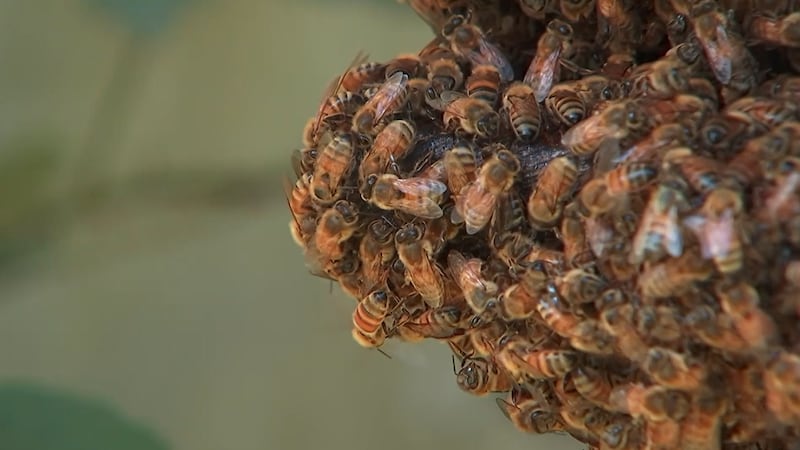
ATLANTA, Ga. (Atlanta News First) — The University of Georgia is training a new generation of “bee doctors” to help protect local hives as beekeepers confront a nationwide honeybee crisis.
Honeybee colonies are collapsing across the country, threatening crops that support Georgia’s agricultural economy and food production nationwide. According to the Honey Bee Health Coalition, honeybees pollinate an estimated $15 billion worth of crops each year.
UGA’s College of Veterinary Medicine is home to a leading veterinary bee health program. Its residency program offers a broad range of training in zoological medicine, with students working with animals ranging from honeybees to whales.
Recognizing a gap in traditional veterinary education, UGA developed a program that introduces students to pollinator care in their first year through the UGA Honey Bee Vet Club. By their fourth year, students complete more than 60 hours of bee-focused education and clinics, culminating in a Certificate in Apiary Health.
The program’s work also drew the attention of biotechnology company Dalan Animal Health, which selected UGA’s College of Veterinary Medicine to conduct field trials for the world’s first honeybee vaccine.
Recent Food and Drug Administration rules classify honeybee hives as food-producing livestock. That designation requires beekeepers to obtain prescriptions from licensed veterinarians before administering certain hive medications.
Dr. Jorg Mayer, a professor of zoological medicine at UGA, said the legal shift reflects honeybees’ role in the food chain.
“The bees were actually a little bit of a loophole ... you raise chicken, poultry, you can’t just go into Walmart or any other store and buy 50 pounds of antibiotics,” Mayer said. “Since 2017, veterinarians now are more and more becoming involved because beekeepers need to involve them.”
Veterinarians must diagnose a hive’s condition before prescribing treatment, rather than simply relying on a beekeeper’s assessment. Mayer said that requirement exposed a gap in veterinary education, where honeybee medicine has not traditionally been part of the standard curriculum.
“With access to the Honey Bee Program and a wealth of local knowledge, our students will be prepared to treat bee colonies exactly as they would any other animal,” Mayer said. “I can offer an opportunity for students to work with a living organism the moment they walk into veterinary school.”
For fourth-year UGA veterinary student Madison Morgan, the hands-on program reshaped her career goals.
Morgan entered veterinary school expecting to work with traditional domestic animals such as dogs and cats. Instead, she discovered a passion for bees.
“It was such an intriguing thought to me, and it just erupted into like this love that I have,” Morgan said. “We’d be out here every Sunday treating the bees, helping feed them. Now I want to keep beehives of my own and work with them.”
During routine hive inspections, finding destructive parasites such as Varroa mites can signal that immediate treatment is needed.
“At that point, it really does hurt. It’s not just maintenance anymore; we need to take action immediately,” Morgan said.
The educational push comes as colonies are dying at historically high rates nationwide. More than 1.6 million honeybee colonies have died across the country, driven by environmental stress, drought and bacterial diseases.
Mayer said the hive must be viewed as a single patient rather than a collection of individual insects.
“The animal to really take care of is the colony,” Mayer said. “The individual bee is literally a blood cell that keeps the organism alive.”
Mayer hopes UGA-trained veterinarians will one day be able to respond to a struggling beekeeper’s call as they would any other veterinary emergency.
“My dream would be the phone rings and a beekeeper says, ‘I think I have an outbreak,’ and those veterinarians would be like, ‘I can be there tomorrow morning at 9 a.m.,’” Mayer said.
Copyright 2026 WANF. All rights reserved.