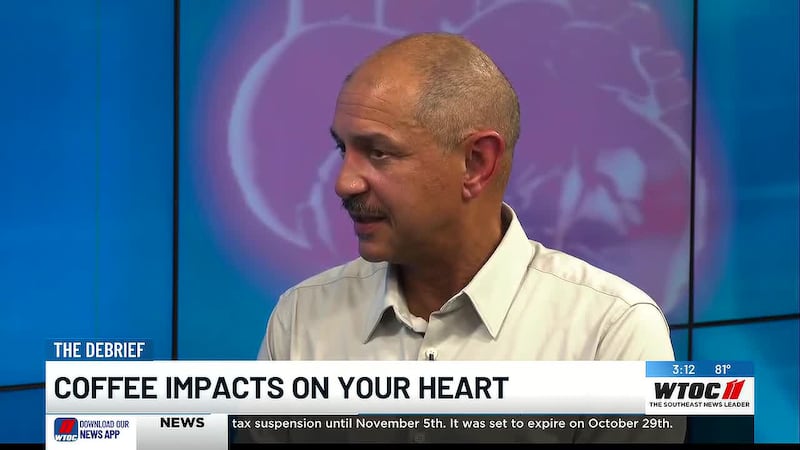
Cardiologist: Moderate coffee drinking unlikely to harm the heart
SAVANNAH, Ga. (WTOC) - Dr. Roy Flood says four to five cups of black coffee a day show no adverse cardiac events in recent study
Cardiologist Dr. Roy Flood said a study published in June found that drinking four to five cups of coffee a day shows no adverse cardiovascular events and may provide some heart benefits.
Study finds lower risk with coffee intake
Flood said that discussion a year ago would have differed.
“If we had this discussion a year ago, I think even most cardiologists would say, hey, that may be a little much,” Flood said. “But a recent study that was just published in June, which is why we’re talking about this, suggests that you can have those four to five cups of coffee without any adverse events and may actually provide some degree of benefit from a cardiac perspective.”
Flood said coffee does increase flutters and palpitations but appears linked to a lower incidence of other serious cardiovascular risks.
“Different rhythm problems may actually decrease with coffee,” Flood said. “And also incidences of thrombotic events like heart attacks, et cetera, may be better with the coffee intake.”
Flood said the findings do not mean everyone should start drinking coffee.
Energy drinks carry more risk than coffee
Flood said the caffeine in coffee should not be confused with the caffeine in energy drinks.
“The energy drinks a lot, a lot more caffeine and a lot more risk from a cardiac perspective,” Flood said.
Flood said energy drinks “really do pack a punch” and that the amounts of caffeine and other additives in them can have an adverse effect on cardiac rhythm.
“They do increase your risk factor for rhythm events, heart attacks, loss of consciousness, et cetera,” Flood said. “So you got to be really careful with the energy drinks.”
Additives change the benefit of coffee
Flood said the benefits discussed apply to black coffee, not coffee with added sugar, cream or other additives.
“Those things kind of change the flavor of this conversation,” Flood said. “And when you’re adding those things, you’re adding sugars, you’re adding fats, you’re adding things that can raise your cholesterol. So that kind of nullifies some of the benefit of those four cups of black coffee.”
Decaffeinated coffee and filtering methods
Flood said decaffeinated coffee carries fewer benefits than caffeinated coffee.
“The caffeine it turns out is really not a bad thing in the doses that we see with a normal cup of coffee,” Flood said.
Flood said some filtering processes, including French press, can raise cholesterol slightly because of what is removed from the coffee during preparation.
Blood pressure and cholesterol effects
Flood said caffeinated coffee may raise blood pressure temporarily but is not expected to cause long-term problems.
“There’s really not going to be any long-term problem from having a cup of coffee in the morning,” Flood said.
Flood said black coffee itself will not raise cholesterol, but additives and certain preparation methods may.
“If you go to your local coffee place and have a cup of black coffee, your cholesterol is going to be fine,” Flood said. “Your heart rhythm may notice a little jolt, but nothing dangerous is going to come of that.”
Caffeine during pregnancy
Flood said pregnant women experience palpitations more commonly during pregnancy and should limit caffeine intake because the fetus is also exposed to it.
“What the mother is drinking, the baby is getting,” Flood said. “Let’s not necessarily stop it if you can handle it yourself, but let’s definitely keep it to a small portion because you’re drinking for the baby.”
Moderation is key, cardiologist says
Flood said moderation applies to coffee consumption, and people without existing heart rhythm issues can likely have a bit more coffee than previously recommended.
“If you already are known to have some heart rhythm disorders, you know, having coffee is probably going to exacerbate that,” Flood said. “So when we’re talking about this, I’m talking about people who don’t already have some underlying issues.”
Copyright 2026 WTOC. All rights reserved.